Resource
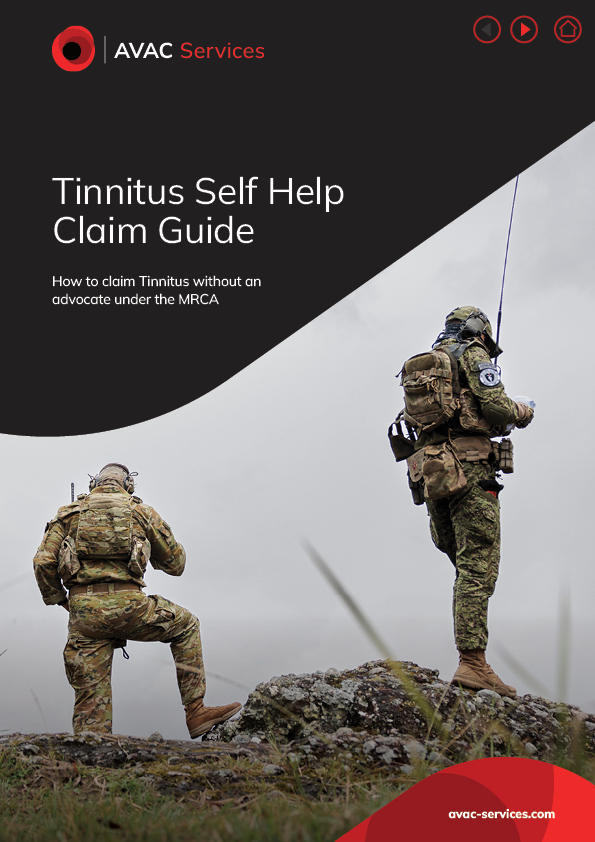
How to claim Tinnitus without an advocate under the MRCA
Living with Tinnitus?
This free self-help guide is intended for current and former Australian Defence Force (ADF) personnel seeking to lodge a tinnitus claim under the Military Rehabilitation and Compensation Act 2004 (MRCA) without the assistance of an advocate. It is designed for:
- Veterans with basic computer access who are comfortable lodging claims independently
- Individuals who have fired weapons or been exposed to loud military equipment
- Those seeking a well-supported claim that meets DVA standards.
Understanding Tinnitus
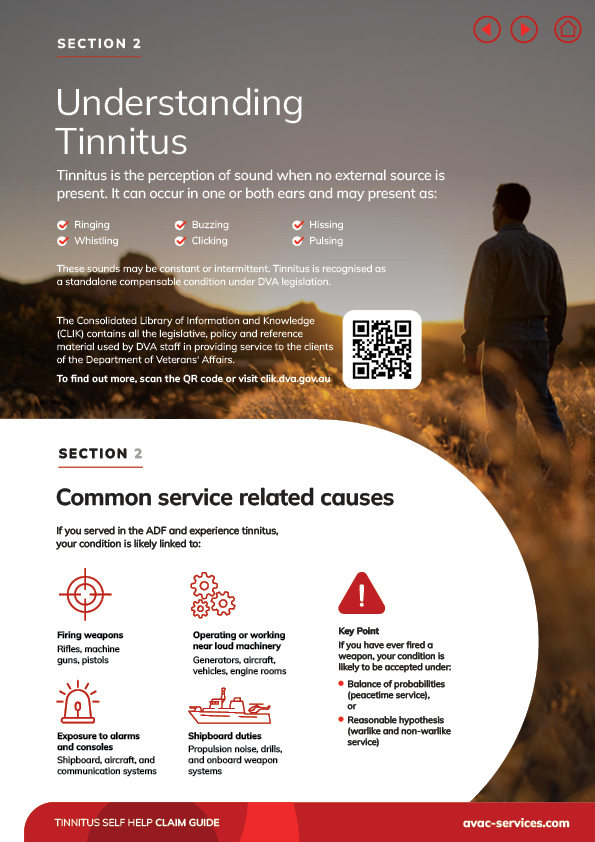
Tinnitus is the perception of sound when no external source is present. It can occur in one or both ears and may present as:
- Ringing
- Whistling
- Buzzing
- Clicking
- Hissing
- Pulsing
These sounds may be constant or intermittent. Tinnitus is recognised as a standalone compensable condition under DVA legislation.
The Consolidated Library of Information and Knowledge (CLIK) contains all the legislative, policy and reference material used by DVA staff in providing service to the clients of the Department of Veterans’ Affairs. To find out more, visit clik.dva.gov.au.
Common service related causes
If you served in the ADF and experience tinnitus, your condition is likely linked to:
Firing weapons
- Firing weapons: rifles, machine guns, pistols
- Operating or working near loud machinery: generators, aircraft, vehicles, engine rooms
- Exposure to alarms and consoles: shipboard, aircraft, and communication systems
- Shipboard duties: propulsion noise, drills, and onboard weapon systems
Key point
If you have ever fired a weapon, your condition is likely to be accepted under:
- Balance of probabilities (non-operational service), or
- Reasonable hypothesis (operational service)
Operational service: Higher chance of acceptance
If you completed operational service after 1 July 2004, your claim may be assessed under the reasonable hypothesis standard of proof. This standard only requires that it is reasonably possible your tinnitus is linked to your service, not that it is more likely than not. This significantly improves your chances of claim acceptance.
Ensure to include any operational deployments and weapon use in your personal statement.
Helpful Tip
Common symptoms of Tinnitus
You may be experiencing tinnitus if you:
- Hear ringing, buzzing, or other phantom sounds
- Notice it worsens at night or in quiet environments
- Have trouble sleeping, concentrating, or regulating mood due to the noise
- Are sensitive to loud or sudden sounds
- Experience fatigue, frustration, or irritability
Note:
When you submit your claim, the Department of Veterans Affairs may require an audiologist visit and a self-reported Tinnitus Functional Index (TFI) questionnaire. Even with a low TFI score, your symptoms are important. Providing a detailed personal statement can help clarify your case.
Evidence you need to gather
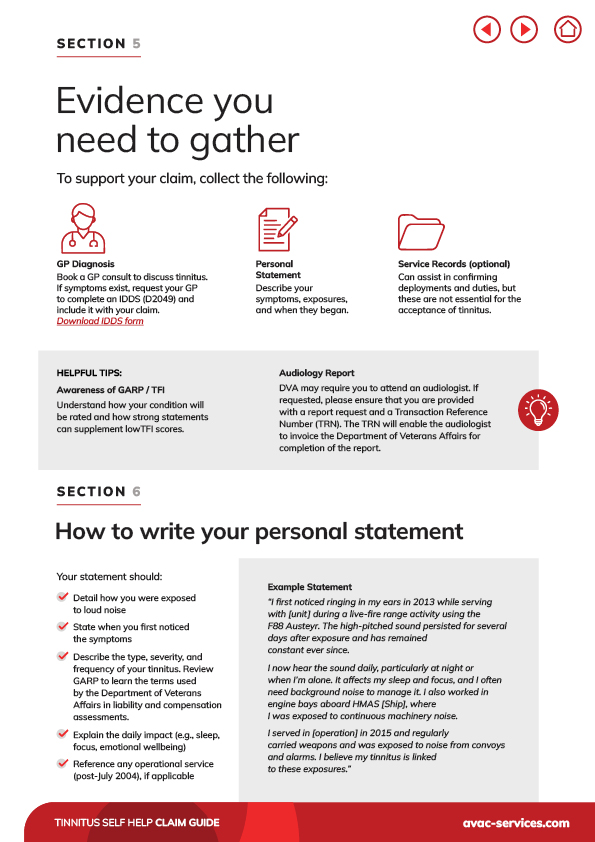
To support your claim, collect the following:
- GP Diagnosis: book a GP consult to discuss tinnitus. If symptoms exist, request an IDDS (D2049) and include it with your claim.
- Personal Statement: dcescribe your symptoms, exposures, and when they began.
- Service Records (optional): can assist in confirming deployments and duties, but these are not essential for the acceptance of tinnitus.
Helpful tips
Awareness of GARP / TFI
Understand how your condition will be rated and how strong statements can supplement low TFI scores.
Audiology report
DVA may require you to attend an audiologist. If requested, please ensure that you are provided with a report request and a Transaction Reference Number (TRN). The TRN will enable the audiologist to invoice the Department of Veterans Affairs for completion of the report.
How to write your personal statement
Your statement should:
- Detail how you were exposed to loud noise
- State when you first noticed the symptoms
- Describe the type, severity, and frequency of your tinnitus. Review GARP to learn the terms used by the Department of Veterans Affairs in liability and compensation assessments.
- Explain the daily impact (e.g., sleep, focus, emotional wellbeing)
- Reference any operational service (post-July 2004), if applicable
Example statement
“I first noticed ringing in my ears in 2013 while serving with [unit] during a live-fire range activity using the F88 Austeyr. The high-pitched sound persisted for several days after exposure and has remained constant ever since.
“I now hear the sound daily, particularly at night or when I’m alone. It affects my sleep and focus, and I often need background noise to manage it. I also worked in engine bays aboard HMAS [Ship], where I was exposed to continuous machinery noise.
“I served in [operation] in 2015 and regularly carried weapons and was exposed to noise from convoys and alarms. I believe my tinnitus is linked to these exposures.”
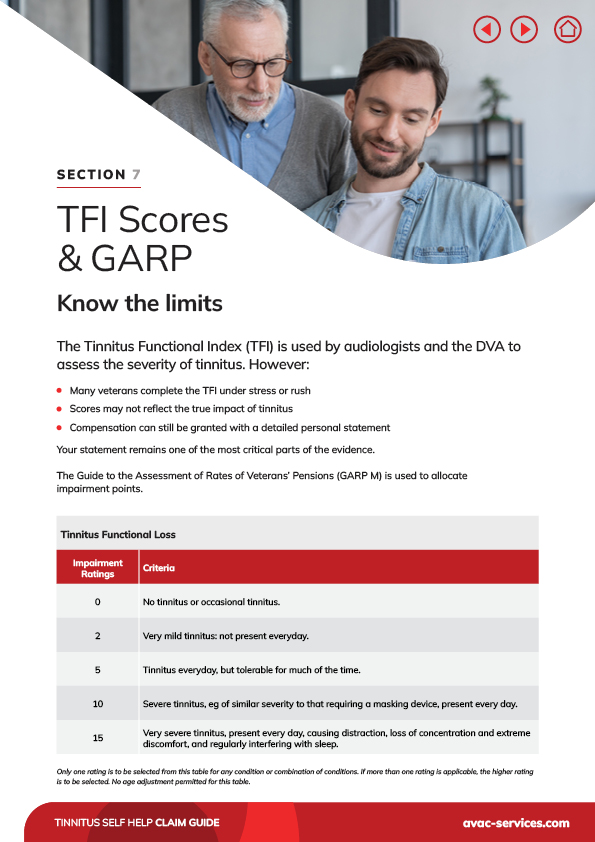
TFI scores & GARP: Know the limits
The Tinnitus Functional Index (TFI) is used by audiologists and the DVA to assess the severity of tinnitus. However:
- Many veterans complete the TFI under stress or rush
- Scores may not reflect the true impact of tinnitus
- Compensation can still be granted with a detailed personal statement
Your statement remains one of the most critical parts of the evidence.
The Guide to the Assessment of Rates of Veterans’ Pensions (GARP M) is used to allocate impairment points.
Tinnitus Functional Loss
| Impairment Ratings | Criteria |
| 0 | No tinnitus or occasional tinnitus. |
| 2 | Very mild tinnitus: not present everyday. |
| 5 | Tinnitus everyday, but tolerable for much of the time. |
| 10 | Severe tinnitus, eg of similar severity to that requiring a masking device, present every day. |
| 15 | Very severe tinnitus, present every day, causing distraction, loss of concentration and extreme discomfort, and regularly interfering with sleep. |
When to seek help
You may wish to contact AVAC Services, an advocate, or legal representative if:
- Your claim is rejected or delayed
- You have comorbid conditions (e.g. PTSD, hearing loss)
- You feel overwhelmed or uncertainabout your statement
- You wish to lodge a review or appeal
- You experience emotional distressassociated with tinnitus
Disclaimers: This guide provides general information only and does not constitute legal or medical advice. Outcomes vary based on the individual evidence submitted. AVAC Services accepts no liability for decisions made based on this material. Always consult a GP, advocate, or legal professional for tailored support.